“Be respectful” my client says to her four year old grandson. That sentence struck me and it made me wonder “how would he know what that means”? So I asked her to define respect as I opened up my infamous white board.
She blanked. Almost like I had asked her to explain something that is a given.
“Respect is …respect!” she says.
She knows what respect feels like her in her body. She knows what it feels like to be in the presence of respect, and she knows what it’s like to be in the absence of respect. But she couldn’t define it or break it down.
That’s the thing about nominalizations — their definition depends on how we hold it in our nervous system. It is subjective and dependent on the perceptual filters we believe to hold value for us. The definition becomes a given, something we do not consider but assume.
Based on that (incorrect) assumption, we believe we are talking about the same thing when use the world, but in truth we might be talking about an entirely different thing.
So my client and I went on a discovery adventure. After inviting her back into her body so she can hear from a deeper, more intimate place, the first thing I did is look up the definition of respect.
The first hit says “a feeling of deep admiration for someone or something elicited by their abilities, qualities, or achievements.” That definition really did not resonate for my client at all. It repulsed her a little, in fact. But it is the primary external definition we found that, undoubtedly, resonates with so many people.
The second definition was “due regard for the feelings, wishes, rights, or traditions of others” and the example they used here was one that made us both laugh because of the cultural tropes associated with it — “young people’s lack of respect for their parents”. This definition also did not resonate.
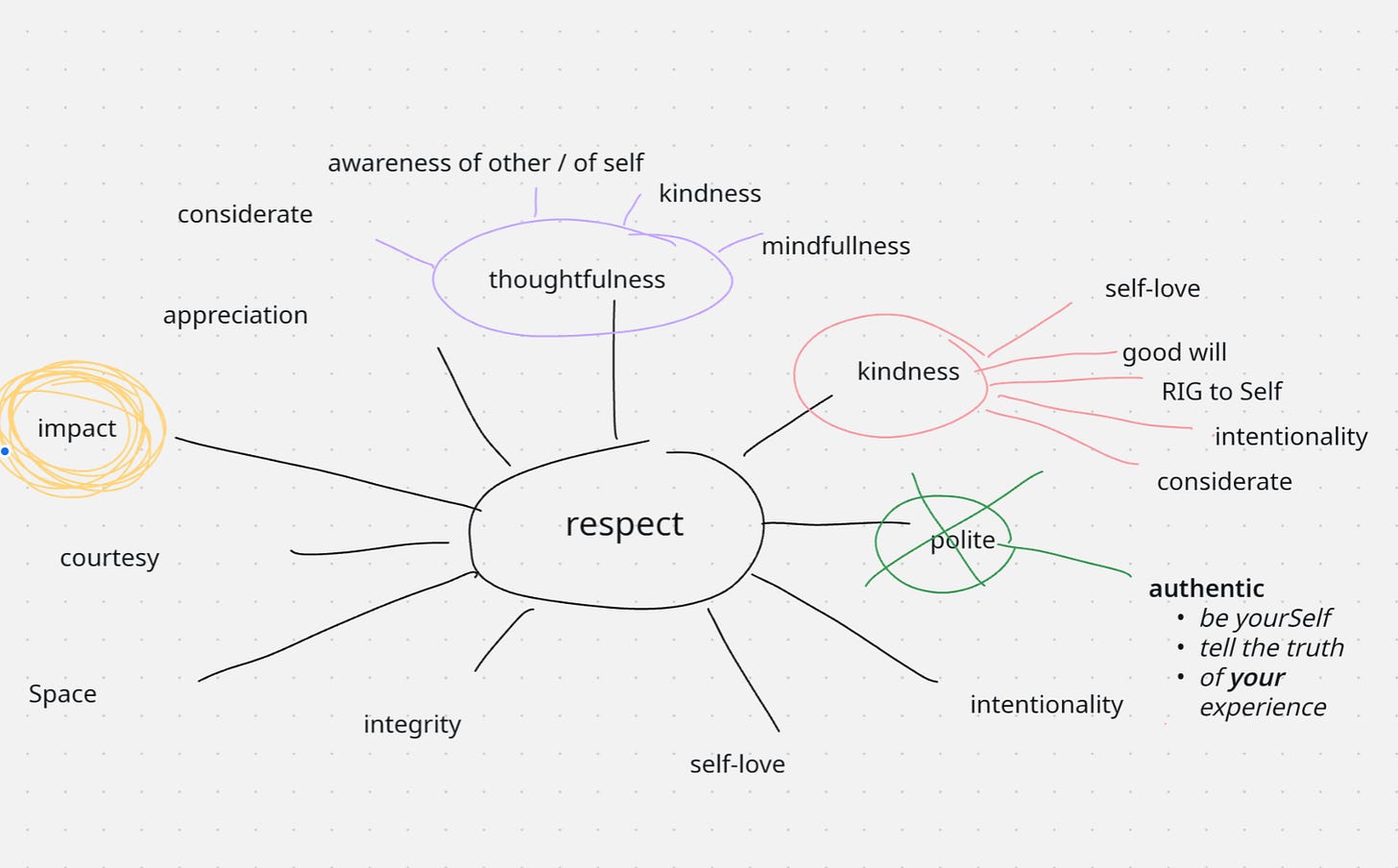
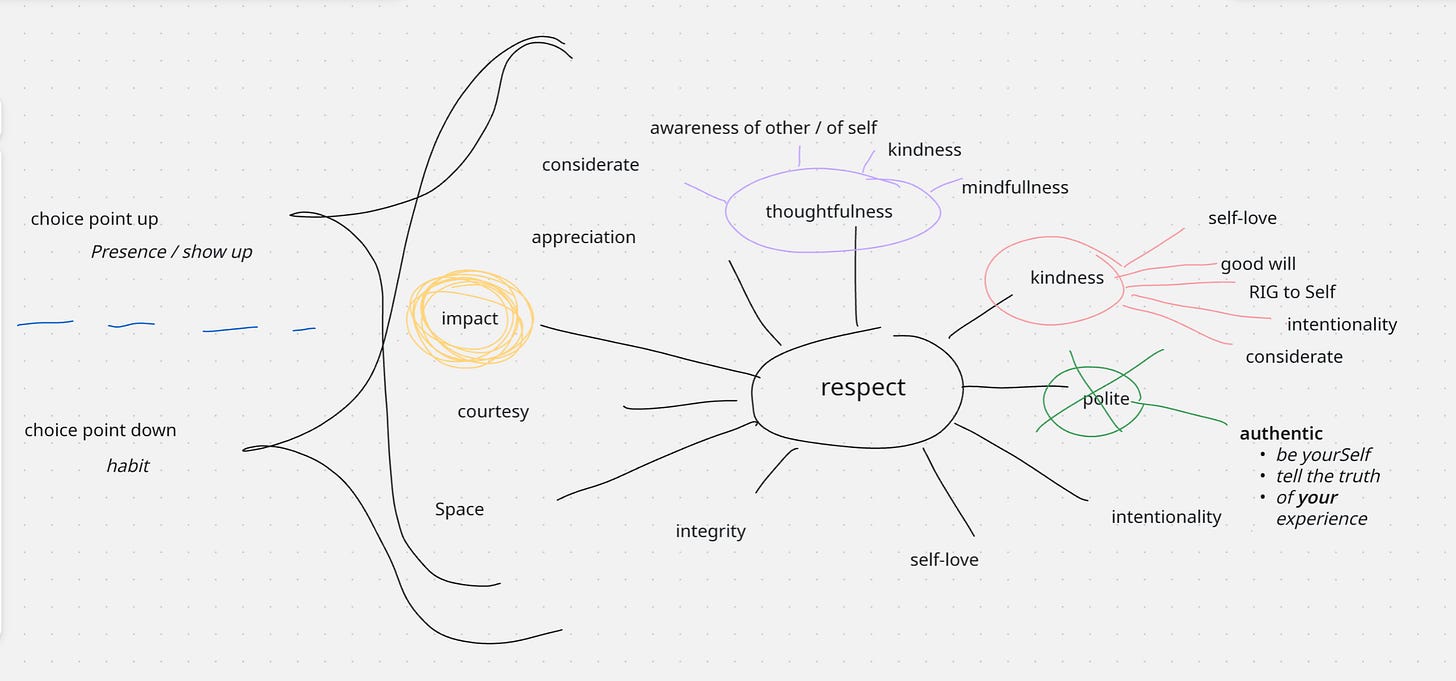
At this point, we decided to explore the synonyms of respect as they emerged through her body. Here’s a glimpse of what we came up with (shared with her permission, of course):
As you can see, when we begin to unpack what we mean, we notice that while we might be using the same word, we don’t mean the same thing.
What might your diagram look like if you were to consider what 'respect' means to you? Feel free to hit reply and let me know!
And for those of you who are familiar with the WEL-Systems® work, you’ll notice the added layer here — how you define each of these nominalization above or below the choice-point makes THE difference.
If we want to communicate effectively with a loved one, first we have to define for one another what we mean. Otherwise, we risk talking over and what we actually mean and end up feeling misunderstood.
Imagine for a moment you are speaking to your husband who believes respect is shown by “a feeling of deep admiration for someone or something elicited by their abilities, qualities, or achievements.” In their world, how they feel respected is by your appreciation of their doing — providing, building, fixing, and so on.
But your definition of respect is rooted in a different belief, one that leaves you feeling respected when your needs are taken into consideration, when you believe that someone can hear you, includes you in process, and considers your well being in their decision-making.
When those two worldviews communicate, they are not talking about the same thing, even though he word they are using is the same.
I hope this illustrates to you the utter significance of unpacking what you mean when you say what you say if you want to communicate clearly what you mean. Maybe you will now hear R-E-S-P-E-C-T differently.
You cannot, of course, control the outcome of how you are received, but you can control how you show up.
This is why so many women dissapear from their own lives. Lack of clarity in communication leads to a feeling of insignificance for our existence. A tough internal place to live from, indeed. Because somewhere deep within, we know: I matter.
If you want to explore this inside yourself, consider this simple exercise:
- Notice where you feel the most misunderstood in your life.
- Pick a word that is meaningful to you yet you can’t seem to be able to communicate it with a loved one.
- Write that word in the middle of the page, then create a brain-map around it. What are other words you associate with that word? Feel free to look it up and play with it, but the most important thing is that whatever you write resonates in your nervous system.
- Once you have a full map, notice where you have been holding back, and notice what gets in the way of your willingness to reveal.
This is what we will be diving deeply into in our upcoming workshop, Who I become when I’m with you.
Details: Thursday February 26th | 11 AM - 1 PM EST | Live | Over Zoom | $97 Can | Replay available | Q&A not recorded
Together, we’ll explore:
- How to decipher what you want to say.
- Noticing which voices get in the way and how to pay attention to the voice you want to live from.
- How to tell what is the voice of truth vs external expectation vs internal dialogue.
- Why this matters in your life.
- How to stay with what’s showing up without losing yourself in the process.
If you are curious about this…